As Principal and co-Investigator, Nyhan has to date won approximately 9 million pounds of third party research funding from AHRC, DFG, the Leverhulme Trust, the European Commission and the Transatlantic Partnership for Social Sciences and Humanities 2016 Digging Into Data Challenge.
Projectlist Menu
- International Digital Oral History Lab
- The Sloane Lab: Looking back to build future shared collections
- Mixed-methods Digital Oral History
- Hidden Histories
- Oceanic Exchanges (OcEx)
- Multimodal Digital Oral History
- CHEurope
- Enlightenment Architectures: Sir Hans Sloane’s Catalogues of his Collections
- Reconstructing Sloane
- Reconstructing the First Humanities Computing Center
- The Digital Humanities Long View

Our mission
Memory, Meaning Making, and Algorithms
As a discipline, practice, and social movement, Oral History captures and preserves personal and collective memories that offer vital insights into lived, human experiences. Digital technologies are now reshaping how we record, access, and interpret these memories. The International Digital Oral History Lab investigates the impact of algorithmic processes, including AI and natural language processing, on oral history research. By combining qualitative and
quantitative methods, our work examines how digital tools influence memory, meaning-making, and historical understanding in an increasingly data-driven world.

Image credit: Dr Daniele Metilli
The project focused on the challenges in bringing digitally together different types of collections across different organisations in ways that potential future users would find usable. The project deliberately sought to bring together natural history collections, books, manuscripts and objects catalogued in different ways on different digital platforms in different institutions. Centring participatory practice, the project worked to understand how different people from different backgrounds, levels of specialist knowledge and interests might want to learn from bringing these collections together, and how to build links across these digital collections in ways that supported rather than hindered their use.

Mixed-methods Digital Oral History
Enfolding semantic web technologies and historical-interpretative analysis to better understand narratives of formation, disruption and change in the history of computing in the Humanities. Deutsche Forschungsgemeinschaft-Arts and Humanities Research Council Bilateral call.

Hidden Histories is a research project into the application of computational methods to the humanities during the period from 1949 to the present. The project conducts, collects and disseminates interviews with scholars and practitioners who were active during this period. Combining the interviews with archival data, new insight is gained into the emergence of a field known today as digital humanities.

Oceanic Exchanges (OcEx)
The dramatic expansion of newspapers over the 19th century created a global culture of abundant, rapidly circulating information. The significance of the newspaper has largely been defined in metropolitan and national terms in scholarship, while digitization by local institutions further situates newspapers in national contexts. OcEx brings together leading efforts in computational periodicals research from six countries—Finland, Germany, Mexico, the Netherlands, the United Kingdom, and the United States—to examine patterns of information flow across national and linguistic boundaries.
Through computational analysis, OcEx also crosses the boundaries that separate digitized newspaper corpora to illustrate the global connectedness of 19th century newspapers. OcEx uncovers how the international was refracted through the local as news, advice, vignettes, popular science, poetry, fiction, and more. By linking research across large-scale digital newspaper collections, OcEx offers a model for data custodians that host large-scale humanities data.

Multimodal Digital Oral History
This site is dedicated to fomenting a new turn in Oral History: Multimodal Digital Oral History. Multimodal Digital Oral History (MDOH) is one that engages with oral history artefacts in multiple representational modalities: transcript, sound, waveform, metadata and more.

“CHEurope” is a PhD training program in cultural heritage supported by the European Union under the Marie Sklodowska-Curie actions (MSCA) – Innovative Training Networks (ITN). The project is the result of a collaboration between key European academic and non-academic organisations in Sweden, the United Kingdom, the Netherlands, Portugal, Spain, Belgium and Italy. With an overall duration of almost 5 years (November 2016 to August 2021), the project has supported the research and training of 15 Early Stage Researchers from Europe and other parts of the world.
Enlightenment Architectures: Sir Hans Sloane’s Catalogues of his Collections is a Leverhulme funded research project based at the British Museum which investigates Sir Hans Sloane’s original manuscript catalogues of his collections. It seeks to understand their highly complex information architecture and the intellectual legacies of this ‘meta-data of the Enlightenment’.

Reconstructing Sloane
In 2010 a core group of senior curators, librarians and scientists from the British Museum, British Library and the Natural History Museum created an informal research consortium to explore ways in which the vast dispersed collections of their common founder Sir Hans Sloane could be understood – by each other, by academic researchers and the general public. On this website you will find information, links and a blog about not only these various projects, but also other Sloane-related projects including PhDs, MAs, and ongoing projects.
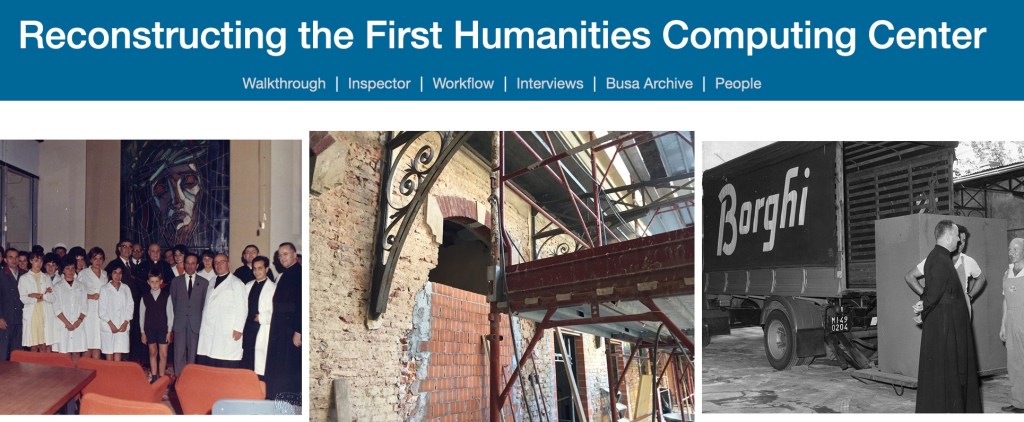
Reconstructing the First Humanities Computing Center
The project as a whole aims to begin the process of reconstructing CAAL (In 1956, Jesuit scholar Roberto Busa, S.J., founded the first dedicated center for humanities computing. Busa named it CAAL, or the Centro per L’Automazione dell’Analisi Letteraria–the Center for the Automation of Literary Analysis) in its multiple dimensions, not in any final way or to settle every question, but to raise new questions, and to reveal what we don’t know about the center and its work. Our goal is to explore the infrastructure, workflow, historical and institutional contexts for this significant site (literally and figuratively) in the history of humanities computing.

The Digital Humanities Long View
A joint seminar series co-hosted by UCL’s Centre for Digital Humanities and the Center for Spatial and Textual Analysis at Stanford.
Technology is global, but where we live affects how we apply digital solutions to humanities work. We all have what Roopika Risam described as a digital humanities (DH) “accent”. This seminar series explores those accents by looking at DH research here, and there, and over there too. This is a chance to build greater global awareness and empathy about regional and local approaches to digital humanities in the twenty-first century.
 juliannenyhan.com